Peter Boose
Job Radar project badgedesigned and in build

A job search.
An ABM program.

A job-search system designed around target accounts, verified proof and one-to-one employer pages.

I’m designing Job Radar on my home lab to run my own search as an account-based marketing program.

How it works
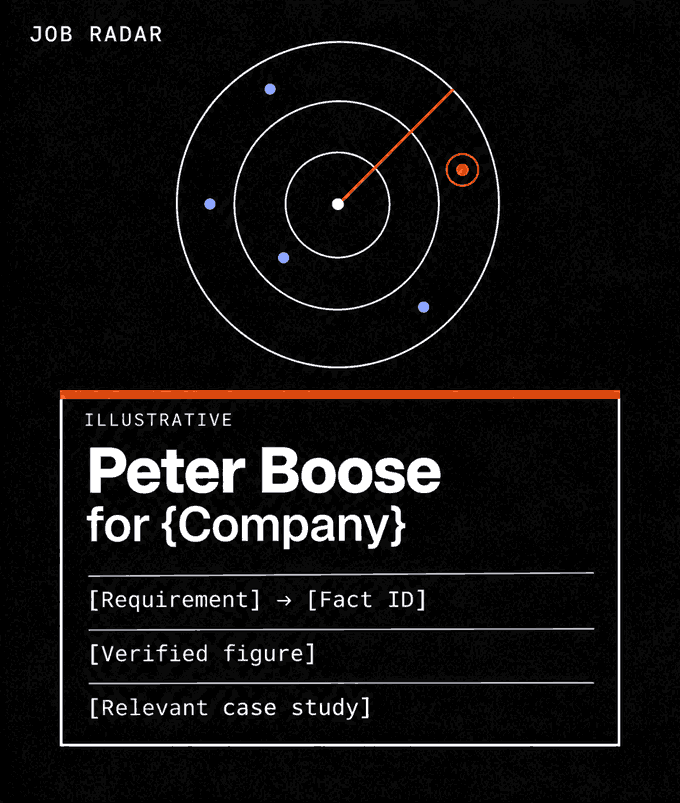
Illustrative Job Radar concept: a radar highlights one target above a tailored employer page for Company, with requirements matched to verified facts.

The problem

A high-volume,
low-signal funnel.

A senior field-marketing job search is a high-volume, low-signal funnel. Roles appear on dozens of company job boards. A generic resume and portfolio get the same treatment as every other applicant.

And you never know whether a hiring team actually looked at your materials.

The ABM idea

One account.
One tailored experience.

A generic portfolio says what I’ve done. A one-to-one page shows which proof matters for a particular role.

The posting sets the brief. Verified facts and case studies supply the proof. An approved, frozen template holds the experience together.

I target accounts, score fit, build a personalized experience for the top accounts, measure engagement and follow up when there’s interest.

Nothing publishes until I approve it.

Illustrative

Peter Boose
for {Company}

[Requirement from posting][Verified proof point][Fact ID] · [Relevant case study]
[Requirement from posting][Verified figure][Fact ID] · [Relevant case study]

Illustrative layout. Placeholder text only.

How it works

  1. Find

    Every night, pull new postings from public job-board feeds for a curated list of target companies. Filter by title, seniority and location.

  2. Score

    Use a local AI model and a verified fact file to score fit. Reject and retry any claimed match that does not cite a real fact ID.

  3. Build

    For Tier 1 roles, draft a one-to-one employer page from the approved, frozen template. Validate it, preview it and wait for my approval.

  4. Track

    Once a day, pull privacy-safe, page-level view counts only.

  5. Follow up

    Open a task when an employer’s page gets its first view or repeat views. AI agents may draft the note. Only I send it.

01 / SYSTEM ARCHITECTUREFive stages. One controlled path.01 FINDjob-board feedsTitle · seniority · location02 SCOREVerified experience → fit tier03 BUILDOne-to-one employer pageApproved, frozen template04 TRACKweb analyticsPage-level view counts only05 FOLLOW UPSuggested task and agent draftI review and sendhome-lab databaselocal model routerMy approval *Required before livewebsite builderand deploy

Inside the AI

Fit is a claim.
It needs a fact.

Constrain the output.

A posting and the verified fact file go into the local model. The output is strict JSON. Each claimed match must cite a real fact ID, or the output is rejected and retried.

Local outages queue the work for retry. Cloud fallback is off by default and runs only when explicitly switched on.

02 / INFERENCE MECHANICSGround the match in real facts.One postingRole requirementsVerified fact fileExperience + fact IDslocal model routerLocal AI on my own hardwareStrict JSONNo free-form claimsFact-ID checkEvery claimed match cites a factAcceptValid fact referencesReject + retryMissing / invalid IDReturn to local modelWHEN LOCAL INFERENCE IS DOWNQueue + retryRetain pending workRetry local modelWhen availableCLOUD FALLBACK / off by defaultExplicit switchOnly when enabledCloud fallbackOptional cloud modelLOCAL FIRST. CLOUD ONLY BY CHOICE.

Make the rubric explicit.

The 100-point rubric weights role, audience, proof, level and logistics. Tier 1 starts at 75, Tier 2 spans 55–74, and Tier 3 is below 55. Company priority can lift a role one tier.

03 / FIT-SCORING LOGICA 100-point rubric.Role30Audience20Proof25Level15Logistics10Tier 175+Tier 255–74Tier 3below 55Company priority can lifta role one tier.
Rubric values are design rules, not performance results.

Guardrails and privacy

Local-first AI

Cloud models run only when explicitly switched on.

Human approval

I approve anything that gets published.

Verified facts

Every fact comes from one verified source.

One deploy path

One source of truth for the site and one deploy path.

A page has to pass the gates.

The validator blocks numbers that do not trace to verified facts, banned phrases and a second company’s name. Employer pages use a random URL suffix and noindex, and stay out of the sitemap.

04 / EMPLOYER-PAGE LIFECYCLEApproval is a state, not a shortcut.DraftApproved, frozen templateValidatedFacts · voice · names · one companyPreviewReview before publicationAPPROVED *By me onlyLive (unlisted)Random suffix · noindexNot in the sitemapRetired and archivedVALIDATOR GATES

A view is a signal, not an identity.

The system never identifies visitors. There are no IP lookups, tracking pixels or enrichment.

The follow-up rules cover first views, repeat views, no view after 7 days and a closed posting. Agents can draft a note; I review and send.

05 / ENGAGEMENT LOOPFollow interest. Keep the boundary.Page viewPage-level counts onlyFollow-up ruleFirst viewRepeat viewNo view after 7 daysPosting closedAgent drafts a noteSuggested next step, not a sendI review and sendOnly I send follow-upPRIVACY BOUNDARYNever collectedVisitor identities · IP lookupsTracking pixels · enrichment

My role

Architect and operator. I designed the system and am directing AI coding agents to build it.

Try it yourself

Install Job Radar in Claude, ChatGPT or Codex to find roles, score fit, build employer pages and draft Gmail follow-ups. You approve what goes out. Includes six page designs, or create one to fit your style.

Install inClaudeChatGPT

Custom domains or self-hosting: Docker or Proxmox, plus hosting API keys.

Status

Designed and in build.

Results (coming)

There are no results or performance metrics to report yet.

Six page designs

All six illustrative employer page designs: Classic, Swiss Grid, Dark Studio, Editorial Serif, One Card and Color Block